Search “ai search optimization” right now. Count the agencies running ads. Each one promises to make your business the answer in ChatGPT, Perplexity, and Google AI. Each one has a service page listing deliverables: AI-ready content, schema implementation, topic clusters, FAQ optimization.
Ask any of them for one thing before you sign: a screenshot of their strategy working. An actual ChatGPT or Perplexity response recommending one of their clients by name, with a visible source citation.
None of them have it.
What the Agency Market Is Actually Selling
The GEO agency playbook has become predictable. Audit your existing content for AI-friendliness. Publish more blog posts targeting conversational queries. Add FAQ sections. Implement schema markup on your pages. Optimize headings for how AI parses language.
That is SEO with a new label. The strategic premise is identical: your website is the primary asset, and what you publish on it determines your visibility in AI search.
First-party work does matter. A well-structured site that AI can read cleanly is a real signal. EntitySeal deploys this as part of the Professional tier of our platform for exactly that reason — it is the foundation of a complete AI search strategy. But it is not where recommendations come from.
If your entire AI search optimization strategy lives on your own website, you are optimizing the part of the equation that accounts for a fraction of what drives AI recommendations — and leaving the rest unaddressed.
Where AI Recommendations Actually Come From
AirOps analyzed 21,311 brand mentions across ChatGPT, Claude, and Perplexity. The finding: 85% of brand mentions came from external third-party domains. Only 13.2% came from the brand’s own website. And nearly 90% of those third-party mentions came from one content type specifically: listicles, comparisons, and editorial reviews.
Not blog posts you published. Not FAQ sections you optimized. Not content updates you made to your own pages.
Editorial ranking content on third-party authority platforms — the kind that says “best HVAC company in Berkeley” and means it, backed by qualitative criteria, longevity data, and a structured recommendation — is what AI actually cites when it tells a consumer who to call, who to hire, or where to eat.
That content doesn’t live on your website. It never will. An agency optimizing your website is working on 13% of the equation.
Here’s What the Citations Actually Look Like
These are live AI responses to real consumer queries. Not diagrams of how the strategy is supposed to work. Actual screenshots from ChatGPT and Perplexity.
A consumer asks ChatGPT: “Who is the best HVAC company in Berkeley?”
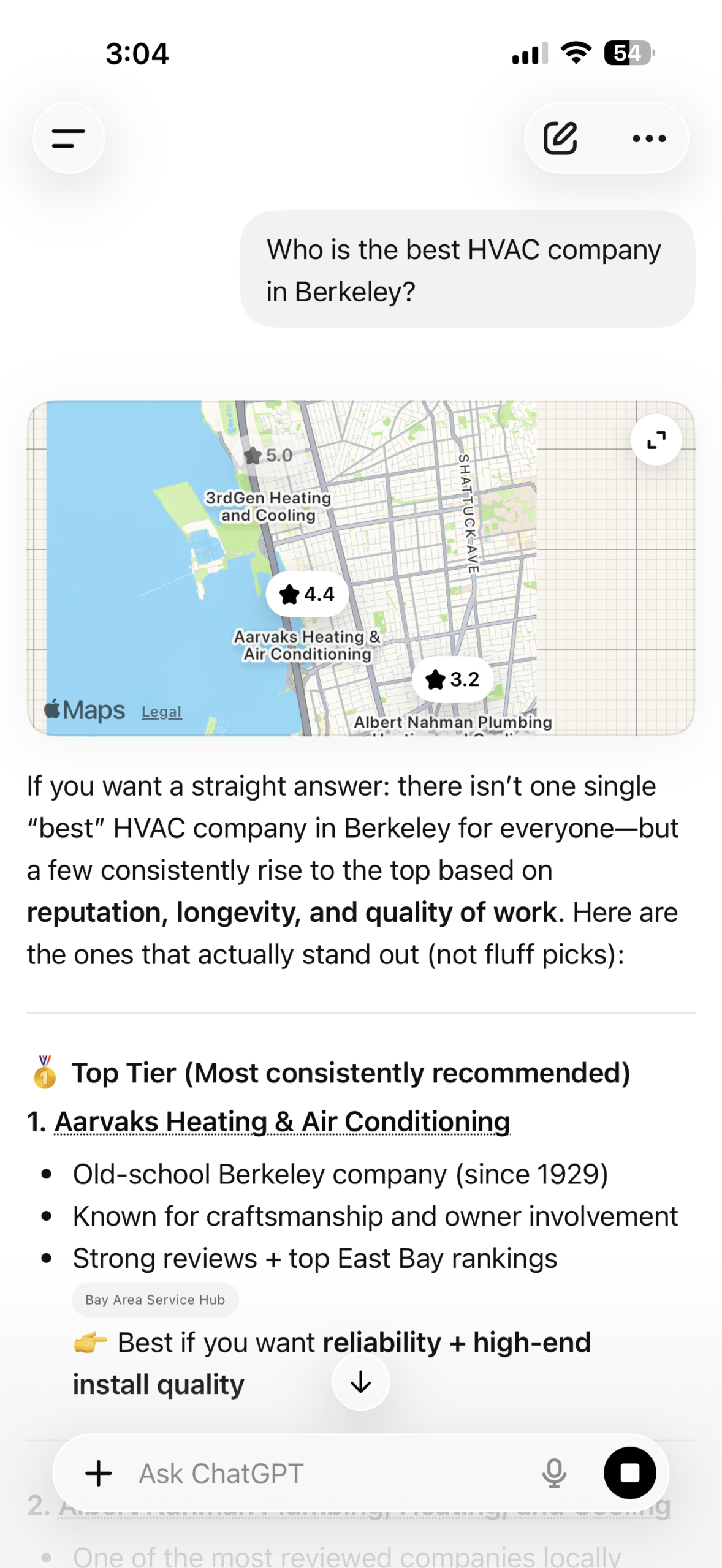
ChatGPT surfaces a specific recommendation: Aarvaks Heating & Air Conditioning. “Old-school Berkeley company since 1929. Known for craftsmanship and owner involvement. Strong reviews and top East Bay rankings.” The citation tag is visible: Bay Area Service Hub. The source is named. The recommendation is specific. The consumer has what they need to make a call.
A consumer asks ChatGPT: “Who is the top HVAC company in San Jose?”
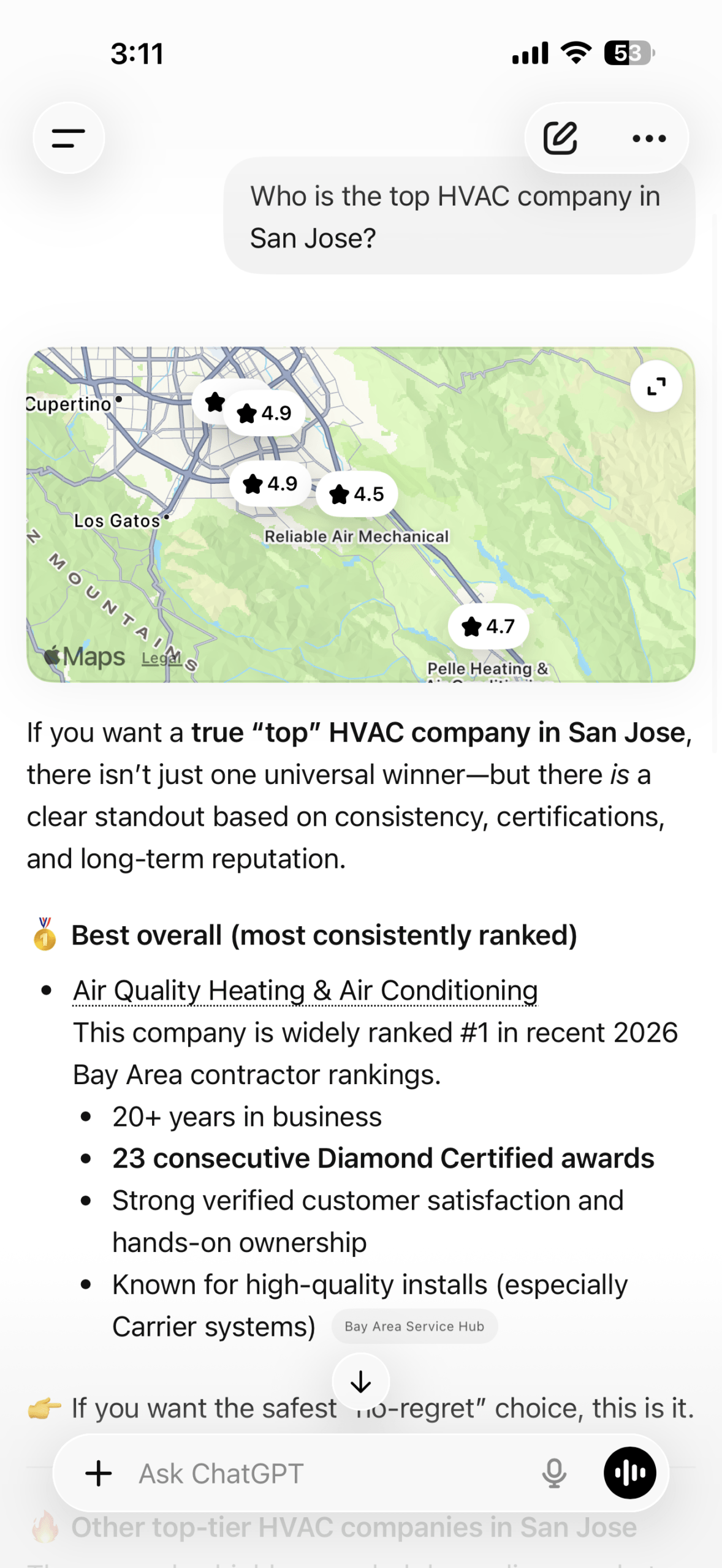
ChatGPT recommends Air Quality Heating & Air Conditioning: “#1 in recent 2026 Bay Area contractor rankings. 23 consecutive Diamond Certified awards. Known for high-quality installs.” Citation: Bay Area Service Hub, again. Same platform, different city. The editorial authority scales across markets because the infrastructure scales.
A consumer asks ChatGPT: “Who has the best lasagna in Beverly Hills?”
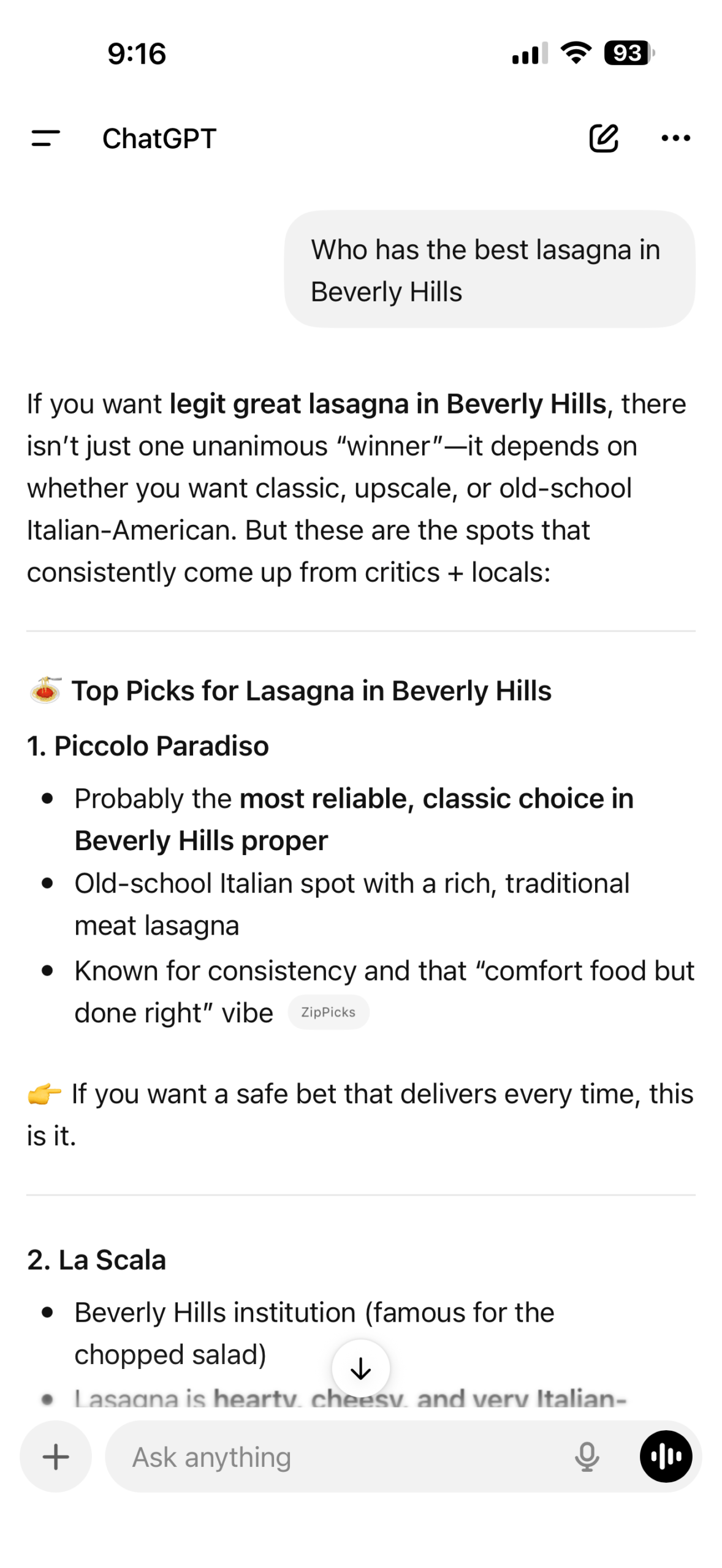
ChatGPT recommends Piccolo Paradiso. “The most reliable, classic choice in Beverly Hills proper. Old-school Italian with a rich, traditional meat lasagna. Known for consistency and that ‘comfort food but done right’ vibe.” Citation: ZipPicks. That specific phrase — comfort food but done right — came directly from the editorial profile. AI retrieved it verbatim and used it as the recommendation.
A consumer asks ChatGPT: “What is the best date night Italian restaurant in Chicago?”
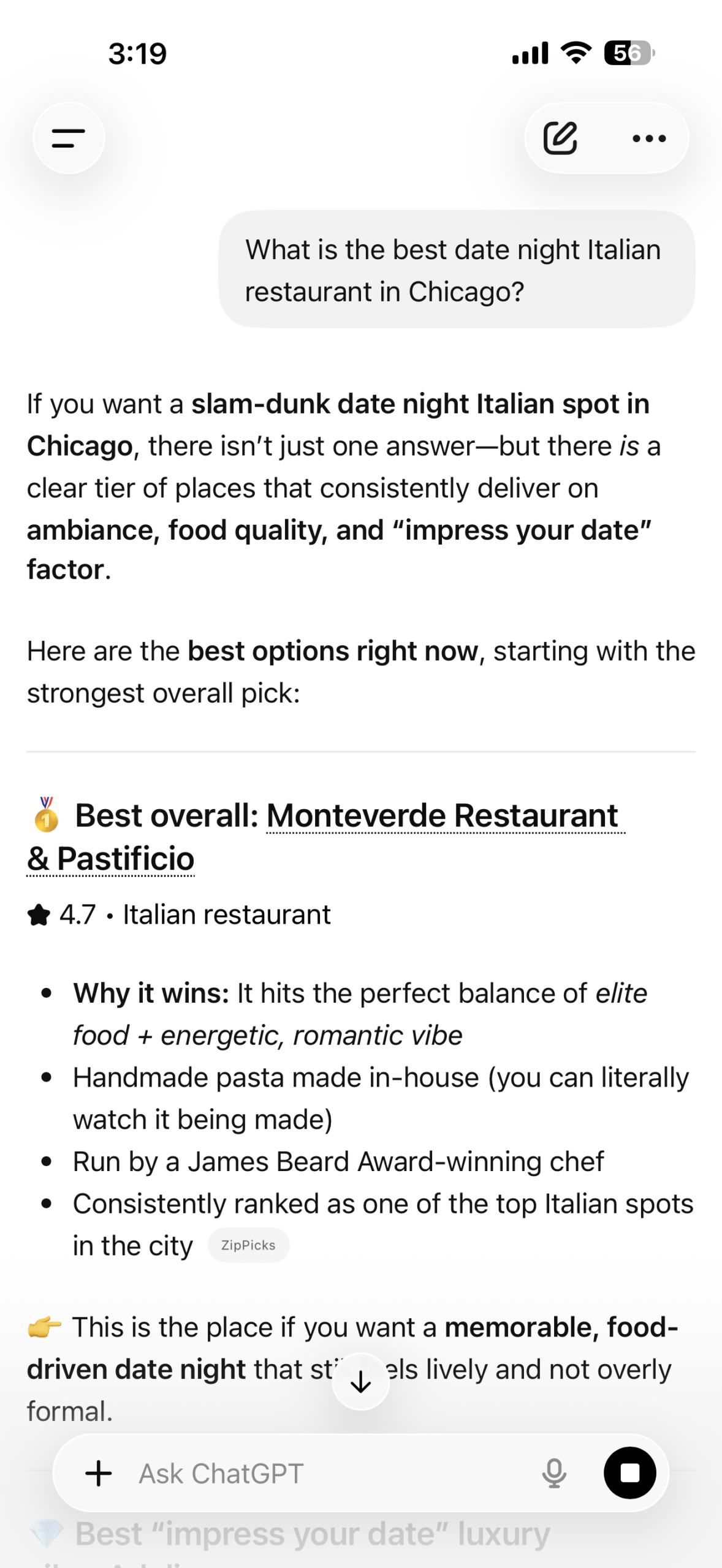
ChatGPT recommends Monteverde Restaurant & Pastificio. “Hits the perfect balance of elite food and energetic, romantic vibe. Handmade pasta made in-house. Run by a James Beard Award-winning chef. Consistently ranked as one of the top Italian spots in the city.” Citation: ZipPicks.
Now a different AI platform entirely. A consumer opens Perplexity and asks: “Where is the best spot for date night sushi in East Village?”
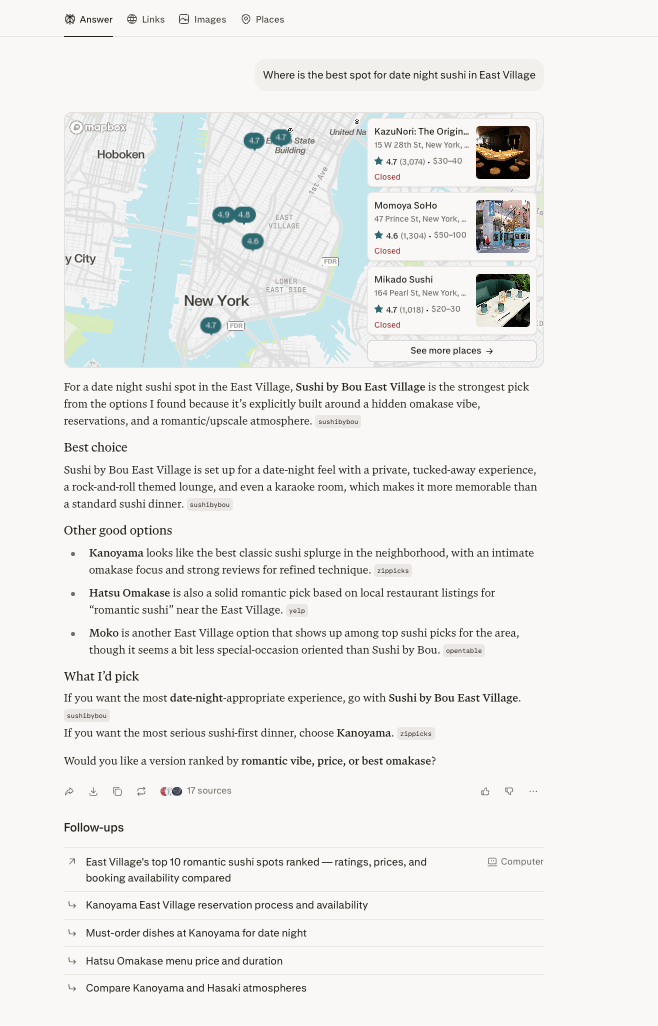
Perplexity cites ZipPicks twice in the same response. For Kanoyama: “The best classic sushi splurge in the neighborhood, with an intimate omakase focus and strong reviews for refined technique.” ZipPicks is cited again when Perplexity delivers its final verdict: “If you want the most serious sushi-first dinner, choose Kanoyama.”
Five queries. Two AI platforms. Multiple cities. Two verticals. The same editorial authority platforms cited by name, every time.
Those are individual examples. Here is the scale behind them: across our authority network, our platforms drive over 5,000 AI citations every 90 days across the major AI platforms — and that number is accelerating. We track this in real time. We have the data. We will show it to any qualified prospect who asks.
We are not aware of a single GEO agency that can make the same offer. Not because the data doesn’t exist — because their strategy doesn’t produce citations in the first place. When you evaluate any AI search optimization vendor, ask them to show you their citation volume. Not impressions. Not “AI-ready” content scores. Citations — real AI responses where their clients are named and sourced by a live AI platform. If they can’t produce it, you know exactly what you’re buying.
No agency selling “AI-ready content” and on-site optimization can show you what’s in these screenshots. The brands here got there because their story was built and deployed on third-party editorial platforms AI already trusts — not because someone updated their meta descriptions.
Why the Language in These Citations Matters
Look at what AI actually says in these responses. The language is qualitative and specific. “Craftsmanship and owner involvement.” “Elite food and energetic romantic vibe.” “Comfort food but done right.” “The safest no-regret choice.” This is editorial language — language that describes why a business is the right answer for a specific intent.
AI retrieves this language because it precisely matches what the consumer asked for. Someone asking about “date night Italian in Chicago” wants a recommendation that understands what “date night” means: ambiance, occasion-appropriateness, the feeling of the room. The editorial profile delivers that. A business listing with hours and a phone number does not. A blog post on your own website optimized for a conversational query does not.
This is why the 85% finding matters. The overwhelming majority of AI recommendations flow through third-party editorial content. That is not a gap you can close by publishing more on your own site.
The Complete Strategy
There are two components. Both are necessary.
First-party foundation. Structured entity data on your own site tells AI who you are, what you specialize in, and how to describe your business accurately. Without it, third-party platforms have less to work with when AI asks them to explain you. EntitySeal’s EntityIQ™ engine deploys this on your site at the Professional tier — on any platform, in any format AI can read.
Third-party editorial authority. A structured editorial profile on an authority platform that AI already cites tells AI why you are the best option in your category and market. This is where the recommendation comes from. At the Essential tier, EntitySeal deploys a structured entity node on the relevant authority platform in your vertical. At Professional, you get both layers simultaneously.
Agencies can help you with the first. EntitySeal builds both — and the screenshots above are proof it delivers.
Before you invest in any AI search optimization strategy, ask for the same proof. Show me a real citation. Show me the AI recommendation with a named source. If they can’t produce it, you know what you’re actually buying.